Know Your Diamond
Learn how to evaluate a diamond based on the “Four Cs” (Cut, Color, Clarity and Carat) and how to balance these measures to select a gorgeous diamond with maximum beauty and brilliance within your budget.
About CUT
Cut is considered to be the most important of all of the diamond characteristics, as a well-cut diamond will often appear larger than a poorly-cut diamond of the same carat weight, and have the appearance of enhanced color and clarity.
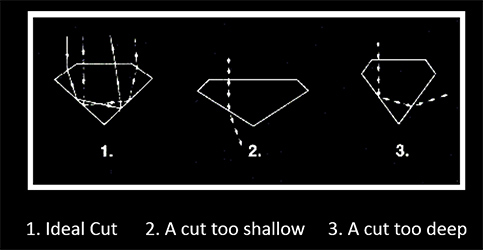 A well-cut diamond is proportioned so that most of the light entering the gem exits back through the top of the stone, perfectly balancing the white light (brilliance) with intense flashes of fire (dispersion). A poorly-cut diamond, with facets cut only a few degrees out of alignment, can result in light exiting through the bottom of the diamond, known as light leakage, instead of from the top where it is visible. This creates a diamond with dulled brilliance from poor light performance within the gem, making the center of the gem look dark.
About COLOR
Color refers to the natural body color of a diamond and not to the reflection of spectral colors that flash when a diamond moves. Most diamonds naturally exhibit slight hints of yellow, brown, or gray. This color is caused by natural trace elements of nitrogen that were present when the diamond formed under the Earth’s crust. The less color a diamond exhibits, the higher the rarity, and therefore the higher the value.
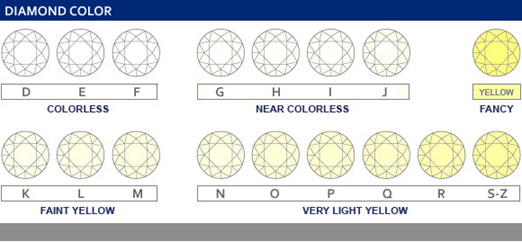 Diamonds with less color allow more light to pass, releasing more brilliance and fire. The international gemological color scale begins with the highest rating of D for colorless, and travels down the alphabet to grade stones with traces of very faint or light yellowish or brownish color.
About CLARITY
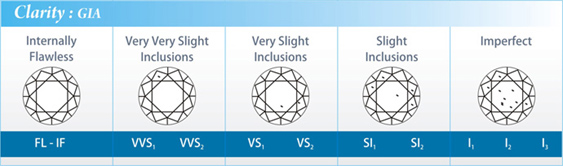
Clarity refers to how clean or clear the diamond is with respect to natural microscopic characteristics that were trapped within or on the diamond while it was forming. Internal characteristics are known as inclusions, and characteristics on the surface of the gem are known as blemishes. Inclusions may be crystals of a foreign material or structural imperfections such as tiny cracks, known as feathers, which can appear whitish or cloudy.
The quantity, size, color, location, orientation, and visibility of inclusions all affect the final clarity grade of a diamond. Diamonds with no or few inclusions are considered particularly rare and highly valued.
About CARAT
Carat (ct.) refers to the unique unit of weight measurement used exclusively to weigh gems and diamonds. Carat weight is often confused with visual size even though it is actually a measurement of weight. Depending on the shape and type of gemstone being weighed, the weight will visually show itself differently. For example, a 1.00 ct. round diamond will measure around 6.5mm, and a 1.00 ct. round sapphire will measure around 6.0mm. This is due to the varying density of different gemstones.
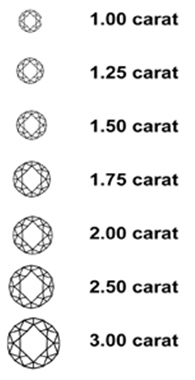 Total carat weight (t.c.w.) is a phrase that represents the total weight of all diamonds or other gemstones in a piece of jewelry, when more than one gemstone is used. Diamond solitaire earrings, for example, are usually quoted in t.c.w., indicating the combined weight of the diamonds in both earrings.
What should you buy?
The Best:
- Clarity – VVS (just because IF is almost impossible to find)
- Colour – DEF
- Cut – Ideal
- Carat – As you wish
Value for Money:
- Clarity – VS
- Colour – GHIJ
- Cut – Ideal
- Carat – As you wish
The Looks:
- Clarity – SI-I
- Colour – FGH
- Cut – Ideal
- Carat – As you wish